
5 Mobile Games Where In-App Purchases Are Actually Worth Your Money
You know the feeling: that quick pang of regret right after you hit Confirm Purchase, watching a few dollars disappear for a skin you’ll forget about by next week. Mobile gaming has built a well-earned reputation as a minefield of pay-to-win shortcuts, randomized loot drops, and “limited time” pop-ups designed to push you into spending you never planned on. That reputation is mostly deserved. Most in-app purchases just aren’t worth it.
But here’s what doesn’t get said enough: a small group of mobile games actually do this right. Their purchases add real, lasting value, fair prices, no manipulation, and no buyer’s remorse. Below, we break down five titles where spending real money pays off, the standard we use to judge “worth it,” and the warning signs to watch for elsewhere.
How We Judged “Worth It”
Each game had to clear three tests:
- Permanence: Will the purchase continue to benefit you over time, or does its value disappear after a future update?
- Transparency: Is it a one-time, clear price, or does it nudge you toward an endless cycle of “just one more” purchase?
- Playability: Can you genuinely enjoy the free version without ever spending a cent?
Any game that hides essential gameplay features behind a paywall didn’t make our list, regardless of how attractive the purchase may seem.
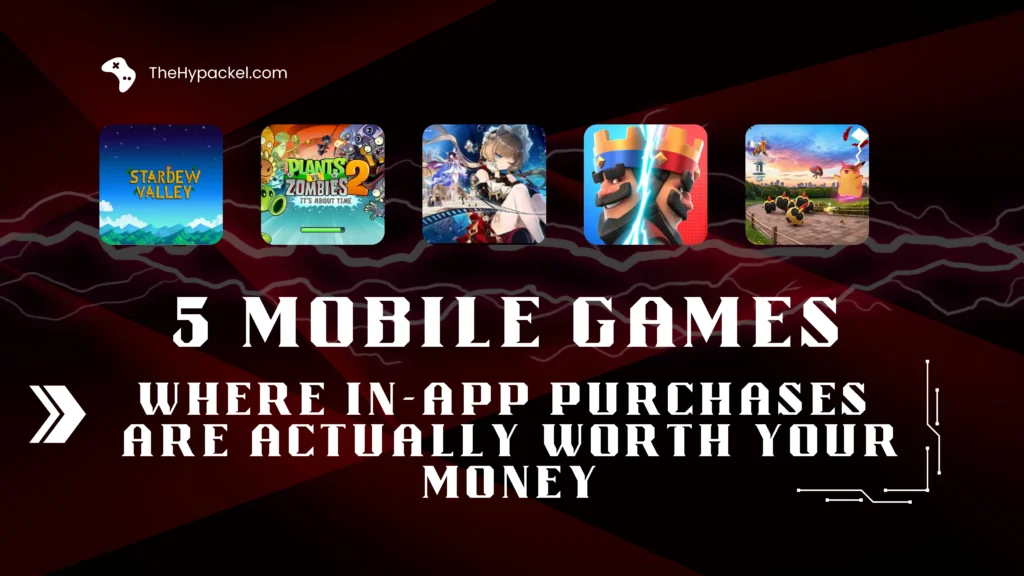
1. Stardew Valley
Stardew Valley barely counts as an “in-app purchase” game at all, and that’s the appeal. You pay once, upfront, and the whole game is yours: farming, fishing, mining, relationships, an entire town to explore. No energy timers, no gem currencies, no interruptions asking you to buy coins mid-harvest.
What sets it apart is the contrast with nearly everything else on mobile. You know the cost before you commit, with no hidden math and no wondering if you’ll get nickel-and-dimed later.
Best For: Gamers sick of freemium mechanics, ready to own a full game outright.
2. Plants vs. Zombies 2
Plants vs. Zombies 2 walks a tightrope most freemium titles fail, and it mostly sticks the landing. Dozens of worlds and hundreds of levels are fully playable without spending anything. Most available purchases focus on convenience boosts or additional plant unlocks that help players progress faster while keeping everything attainable through normal gameplay.
The key is balance: you’re never blocked from advancing just because you didn’t pay. Purchases exist for players who want to skip the grind, not for players with no other way forward.
Best For: Casual players who want faster progression without feeling pressured to make purchases.
3. Genshin Impact
Genshin Impact draws plenty of fair criticism for its gacha-style character pulls, but underneath that system sits something genuinely well built: the Battle Pass. For a modest monthly fee, players unlock a structured reward track delivering a steady flow of in-game currency, crafting materials, and character experience, a value that comfortably beats what the same money would get from random pulls.
It’s one of the few major free-to-play games that consistently rewards regular players instead of pushing them to spend out of frustration.
Best for: players who log regular playtime and want their spending to go further than gacha luck allows.
4. Clash Royale
Clash Royale’s Pass Royale follows a similar idea to Genshin’s battle pass, and it’s become something of an industry benchmark for fair monetization. A single purchase unlocks a season-long track of chests, gold, gems, and cosmetics, none of which gives paying players a card that’s mechanically stronger than what free players can access.
That distinction matters: Clash Royale’s competitive balance depends on skill, not spending power, and the developers have largely kept it that way.
Best For: Competitive players who want faster progression without compromising the game’s skill-based core.
5. Pokemon GO
Pokemon GO keeps its purchases almost entirely cosmetic and convenience-focused: outfits, extra storage for items and Pokémon, and incubators that speed up hatching. None of it touches your ability to catch, battle, or compete. The core loop, walking around, finding Pokemon, and taking on gyms, stays completely free.
What earns Pokemon GO a spot here is restraint. Niantic could have locked stronger Pokemon or battle advantages behind a paywall and chose not to.
Best for: Long-time players who’ve outgrown their starting storage and want quality-of-life upgrades.
Red Flags to Watch For in Other Games
- Energy or lives systems: Built specifically to interrupt your fun right when you’re most likely to pay to keep going.
- Loot Boxes: Randomized rewards dressed up as exciting surprises that function, in practice, as gambling aimed at players who may not even realize that’s what’s happening.
- Countdown Timers: Urgency tactics meant to short-circuit careful decision-making.
- Pay-to-win Mechanics: Give paying players a measurable edge, turning skill-based games into spending contests.
Tips for Spending Smart on Mobile Games
- Set a monthly gaming budget before you ever open a store menu, and treat it as a hard limit, not a suggestion.
- Wait for seasonal sales or bundles instead of buying the moment something catches your eye.
- Search specifically for reviews on a game’s monetization fairness, not just its gameplay, before you spend.
- Play the free version thoroughly first; a game that feels good without spending any money, then far more likely to feel good after you spend a time.
Final Thoughts
Good in-app purchases are uncommon, but they do exist. The games featured in this list show that thoughtful monetization can add value without constantly pushing players to spend more. If you’re considering making a purchase in a mobile game, these titles are a great place to start. Most of them offer generous free experiences, allowing you to decide whether an upgrade is truly worthwhile before spending any money. If you know another mobile game with genuinely worthwhile in-app purchases, share it with us, we’re always interested in discovering titles that put players first.